NSQIP abstraction that fills itself in from Epic.
The Surgical Quality AI Platform watches surgical patients for 30 days after discharge, catches complications early, and pre-populates the NSQIP record from Epic - with a clinician in the loop at every step. Built on the same proven foundation as AFCDAI, in production in Ontario since 2023.
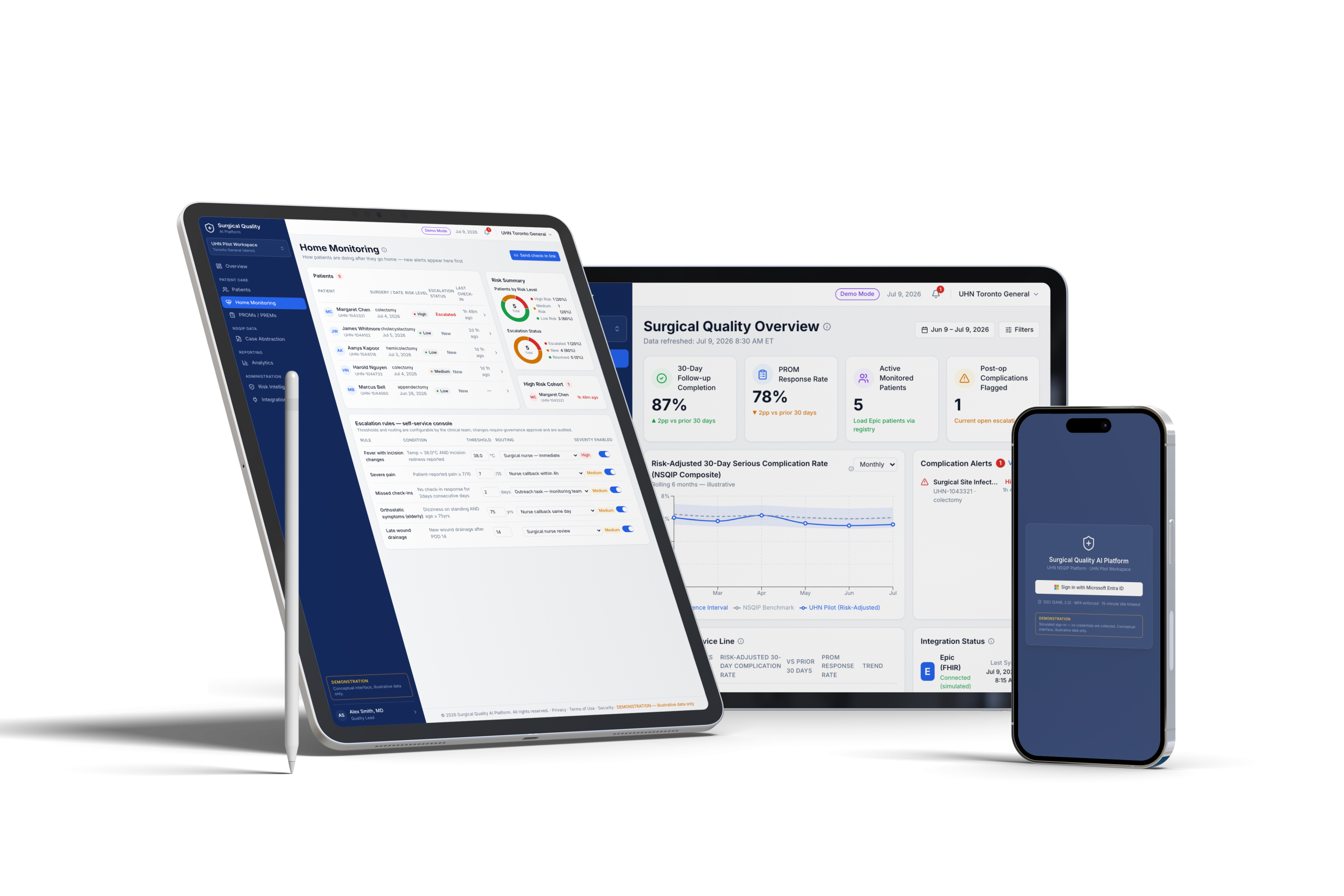
One platform, four roles,
zero duplicate entry.
From the QI committee to the surgical clinical reviewer's worklist, everyone works from the same live surgical record - with role-based access mapped to your identity provider.
Quality Leadership
See 30-day follow-up completion, complication flags, and risk-adjusted outcomes without waiting weeks for manual reporting.
- Live executive overview
- O/E ratio vs NSQIP benchmark
- Quality by service line
Surgical Clinical Reviewers
Your SCRs / NSQIP abstractors start the day from a prioritized worklist instead of searching multiple systems - then confirm pre-filled fields rather than re-keying them.
- Prioritized case worklist
- Field-by-field source ledger
- Missing-data & follow-up filters
Surgical Teams
Get flagged the moment a discharged patient reports fever plus incision redness - not when they arrive at the ER a week later.
- Rule-based escalations
- AI risk with evidence & confidence
- Accept / adjust / override controls
Patients at Home
A secure text-message link - no app to install, no password. A two-minute check-in keeps the care team watching without a single phone call.
- SMS symptom check-ins, Day 3-30
- PROMs & wound photo upload
- Automated reminders & phone fallback

Every NSQIP field:
value, source, status.
The field ledger shows exactly where each value came from, so your surgical clinical reviewer (SCR) confirms instead of re-keys. Epic pre-fills what it knows, the patient reports what happened at home, and the AI flags what needs a human eye.
- Procedure, dates, ASA class, labs arrive automatically over SMART on FHIR - no searching, no duplicate entry.
- Readmission, ED visits, and symptoms come straight from structured patient check-ins, mapped to NSQIP occurrence definitions.
- AI-flagged fields show their confidence - a "Needs review" SSI flag is confirmed or dismissed by a person, never auto-committed.
- Data quality checks run continuously - required fields, validation rules, and logic checks before anything reaches the registry export.

The 30 days you
couldn't see - until now.
Most NSQIP occurrences happen after discharge, where today's workflow is phone tag and hope. The platform texts each patient a secure two-minute check-in on a pathway-specific schedule - Day 3, 5, 7, 14, 30.
- No app, no password - a secure SMS link opens a simple form: pain scale, incision appearance, fever, ED visits, readmission, optional wound photo.
- Flagged answers escalate instantly - fever above 38°C plus incision redness routes to a surgical nurse immediately; severe pain books a callback; missed check-ins create an outreach task.
- The AI re-scores risk on every response - a complication signal on Day 5 surfaces the case the same morning, not at the 30-day review.
- Escalation rules are yours to tune - thresholds and routing are configurable by the clinical team, with every change governed and audited.
Five steps from surgery
to a complete NSQIP record.
Each case flows through the same governed pipeline - pre-filled from Epic, completed by the patient, reviewed by a clinician, exported to the registry.
Sync
Surgical cases and discharge events arrive from Epic over SMART on FHIR and HL7v2 ADT - fields validated against NSQIP definitions.
Monitor
Patients get scheduled SMS check-ins after discharge - 30-day postoperative outcomes, PROMs, ED visits, and readmissions captured digitally.
Score
Risk models re-score SSI, serious complication, and readmission on every new data point - with evidence and confidence shown.
Review
Clinicians accept, adjust, or override every AI estimate; abstractors confirm the pre-filled ledger. Nothing auto-commits.
Export
Clean, validated case data flows to the NSQIP-aligned registry export - staged, checked, and fully audited.
AI you can govern,
not just believe.
Every model ships with a card, a validation report, and a bias review - and the full lifecycle works: suspend, rollback, retire. If you ever lose confidence, one click takes a model offline and everyone reverts to the manual workflow.

Held-out validation
Sensitivity, specificity, and AUROC on a hold-out set - versioned metrics for every release, validated on your population before go-live.
Drift monitoring
Feature drift, calibration drift, alert rate, and override rate tracked continuously against thresholds - with a hard drift floor.
Human in the loop
Every estimate shows evidence and confidence. Overrides require a documented reason and are retained for governance reporting.
Suspend · Rollback · Retire
Full model lifecycle controls, working in the product today - not a policy document, a button.
Bias & equity reviews
Scheduled re-reviews by the Clinical AI Committee, with model cards, datasheets, and approval records for every version.
Immutable audit trail
Logins, AI outputs, re-scores, overrides, escalations, and exports - every event logged, attributable, and exportable.

QI answers in seconds,
not quarterly binders.
Risk-adjusted complication trends with the observed-to-expected (O/E) ratio, semiannual-report-style NSQIP benchmark comparison, service-line performance, and 30-day longitudinal outcome tracking - filterable by site, specialty, surgeon, and procedure.
- Executive insights summarize the program for the QI committee - generated from live data, not last quarter's spreadsheet.
- Custom report builder produces committee-ready files on demand; research exports ship as de-identified CSV plus FHIR bundles.
Nothing leaves Canada.
Nothing goes unaudited.
Only the data elements you approve ever leave Epic - and from there, everything stays inside a Canadian boundary. PHIPA + PIPEDA aligned, encrypted everywhere, with enterprise SSO and role-based access mapped to your identity provider.
Canadian residency
Hosted in AWS ca-central-1 (Montréal). Patient data never crosses the border.
Encrypted everywhere
TLS 1.2+ in transit, AES-256 at rest, keys managed in Canadian KMS.
Enterprise SSO + RBAC
SAML 2.0 with Microsoft Entra ID, MFA enforced, least-privilege roles per function.
No external AI APIs
Models run inside the platform boundary. Patient data is never sent to third-party AI services.
A browser portal first.
An API when you want it.
Primary delivery is a portal integrated with Epic - no UI for your team to rebuild. A documented REST API, FHIR integration, and signed webhooks are there for teams that want to embed or automate.
Epic EMR connection
Industry-standard, permissioned OAuth2 connection. Only the specific data elements you approve are shared - demonstrated live against Epic's sandbox.
ADT feed & event delivery
HL7v2.5.1 over MLLP for admission/discharge events; outbound webhooks signed with HMAC-SHA256, retried with exponential backoff.
OpenAPI 3.1, OAuth2, TypeScript SDK
Patients, cases, questionnaire responses, and NSQIP-aligned exports - full reference and SDK provided to your technical teams. Cerner, REDCap, PowerBI, and SFTP connectors available per deployment.
{
"period": "2026-Q2",
"cases_staged": 12,
"validation_errors": 0,
"fields_prefilled": "epic + patient-reported",
"review_status": "abstractor-approved"
}
// Every export is validated, staged & audited
→ status: "ready"
→ transfer: "secure"
Your data. Your abstractors.
Your success criteria.
The fastest way to verify everything on this page is a pilot - one service line, measured against criteria you approve: minutes per case, fields auto-populated, follow-up completion, and time from discharge to complication flag.